
Faculty Support (CPL Process and FAQ
Faculty play a critical role in recognizing and honoring the depth of students’ lived and professional experiences. Through their expertise, they determine how prior learning meets course learning outcomes, ensuring students receive meaningful credit for their prior learning, while upholding academic rigor and disciplinary integrity.
CPL Faculty Workflow
Faculty Role in Credit for Prior Learning
Faculty expertise makes it possible to recognize and validate learning beyond the classroom. Review how faculty evaluate CPL evidence, confirm course eligibility, and support the CPL process.
Faculty responsibility
- Evaluate alignment of CPL evidence with course learning outcomes.
- Approve or deny awarding CPL credit.
- Assign a grade, where appropriate.
Course eligibility
- Courses must be designated as CPL eligible through the curriculum approval process and/or the Curriculum Office.
- Approved courses are identified in the catalog as eligible for CPL.
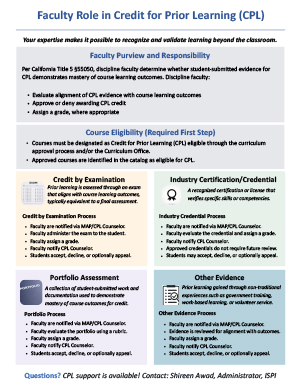 View the Faculty Role in Credit for Prior Learning PDF
 Accessible text version of the Faculty Role in Credit for Prior Learning flyer
Faculty Role in Credit for Prior Learning
Faculty expertise makes it possible to recognize and validate learning beyond the classroom.
Faculty purview and responsibility
Per California Title 5 §55050, discipline faculty determine whether student-submitted evidence for Credit for Prior Learning demonstrates mastery of course learning outcomes. Discipline faculty:
- Evaluate alignment of CPL evidence with course learning outcomes.
- Approve or deny awarding CPL credit.
- Assign a grade, where appropriate.
Course eligibility: required first step
- Courses must be designated as Credit for Prior Learning eligible through the curriculum approval process and/or the Curriculum Office.
- Approved courses are identified in the catalog as eligible for CPL.
CPL assessment methods
Credit by Examination
Prior learning is assessed through an exam that aligns with course learning outcomes, typically equivalent to a final assessment.
Credit by Examination process
- Faculty are notified via MAP/CPL Counselor.
- Faculty administer the exam to the student.
- Faculty assign a grade.
- Faculty notify CPL Counselor.
- Students accept, decline, or optionally appeal.
Industry Certification/Credential
A recognized certification or license verifies specific skills or competencies.
Industry Credential process
- Faculty are notified via MAP/CPL Counselor.
- Faculty evaluate the credential and assign a grade.
- Faculty notify CPL Counselor.
- Approved credentials do not require future review.
- Students may accept, decline, or optionally appeal.
Portfolio Assessment
A portfolio is a collection of student-submitted work and documentation used to demonstrate mastery of course outcomes for credit.
Portfolio process
- Faculty are notified via MAP/CPL Counselor.
- Faculty evaluate the portfolio using a rubric.
- Faculty assign a grade.
- Faculty notify CPL Counselor.
- Students accept, decline, or optionally appeal.
Other Evidence
Other Evidence includes prior learning gained through non-traditional experiences, such as government training, work-based learning, or volunteer service.
Other Evidence process
- Faculty are notified via MAP/CPL Counselor.
- Evidence is reviewed for alignment with outcomes.
- Faculty assign a grade.
- Faculty notify CPL Counselor.
- Students accept, decline, or optionally appeal.
Questions?
CPL support is available. Contact Shireen Awad, Administrator, ISPI.
Frequently Asked Questions
*Faculty are encouraged to also see the Student FAQ to better assist students with CPL opportunities/questions.
- Research suggests that CPL benefits students and colleges by increasing completion and closing achievement gaps. In California, this means CPL can help the system achieve the goals outlined in the Vision for Success and increase college funding through improving measures on the Student Centered Funding Formula metrics.
- CPL advances economic mobility and works towards dismantling systemic barriers for all Californians (Credit for Prior Learning as an Equity Lever, 2020).
- CPL increases the probability of enrollment in a community college by 54% (Strada Recontact Survey (2022) as cited by ASCCC IE Regional Consortium, 2024).
- CPL benefits both colleges and students by increasing completion and closing equity gaps (Credit for Prior Learning Policy Implementation Toolkit, n.d.)
- To explore other benefits and a general overview of CPL, please view the Credit for Prior Learning (CPL): Advocating for Student Access & Success Presentation.
AP 4235 Credit for Prior Learning is a great resource to learn more about the different methods of assessment that Chaffey accepts for Credit for Prior Learning.
- CPL Lead Evaluator: carri.reyes@chaffey.edu
- CPL Faculty Lead: nicole.derose@chaffey.edu
- Military/Veteran Credit: vrc.staff@chaffey.edu
- Counseling Department: counseling@chaffey.edu
Under the revised Title 5, § 55050(f), effective September 9, 2026:
“Sufficient mastery” means having attained a level of knowledge, skill, and information equivalent to that demonstrated generally by students who receive the minimum passing grade in the course.
The assessment can be created by discipline faculty. Discipline faculty may also use an outside assessment (Title 5 § 55050). In either case, discipline faculty have the sole responsibility to determine if an assessment measures the mastery of course content outlined in the COR.
- CPL credit can be awarded for courses in general education, major courses, and/or elective courses. Courses must be approved for CPL through the Curriculum Committee.
- Please note the CSU and UC Policies on CPL.
Any course in the Chaffey College Catalog that has the following statement, “Credit for Prior Learning: Yes”.
All courses eligible for CPL have the “Credit for Prior Learning: Yes” indicated in the Chaffey College Catalog course description.
Please contact the Curriculum Office for detailed instructions. Please note, it is important to check with your discipline faculty colleagues in regards to adding CPL to a course.
