
Chaffey College Anthropology Professor Unearths Opportunities for Students
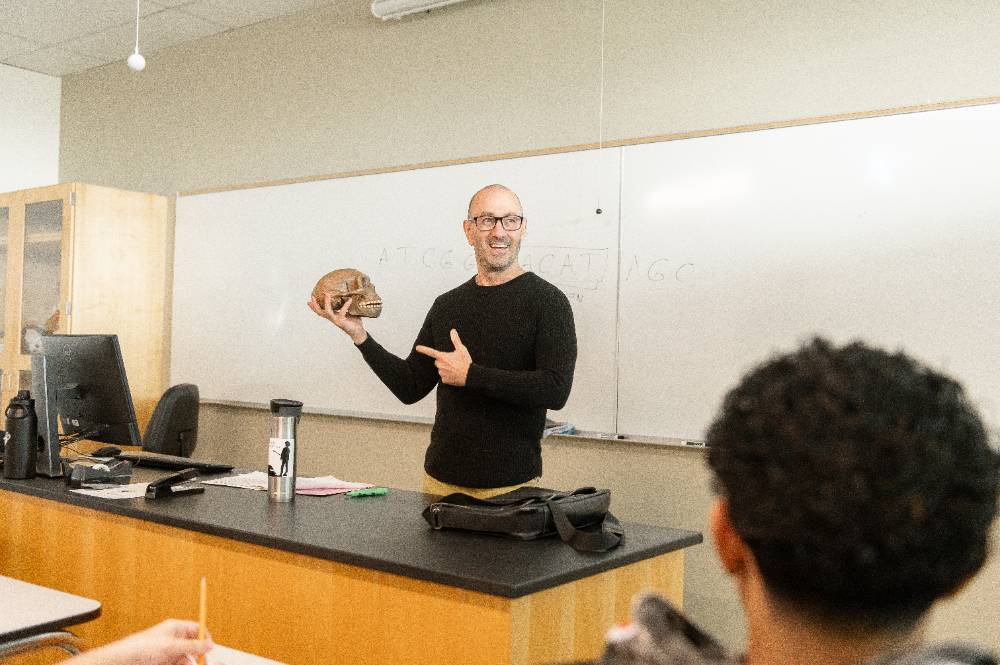
Marc Meyer worked hard in his early 20s supporting his family’s lamp manufacturing business in Queens, NY. But during those long hours in his delivery truck, he found himself yearning for something more as he listened to NPR stories about scientific discoveries in distant lands.
“It was always a dream to leave that life behind, and I never really thought I would be able to until I went to college,” he said.
Now Meyer works with teams of anthropologists from around the globe, examining two of the oldest fossils of human evolution known to man. As a professor at Chaffey College, Meyer includes his students in research opportunities to give them academic and career experience.
A New York native, Meyer watched documentaries as a child and was a fan of National Geographic specials. But being part of the family business didn’t leave much room for dreams of unearthing fossils.
“When you work with your parents, they discourage you from going off and doing your own thing,” he said.
For 12 years after he graduated high school, Meyer did lamp deliveries. When he finally enrolled at Queens College, he continued working full time during the day and took classes at night. Meyer graduated summa cum laude and later earned a Ph.D. in anthropology from the University of Pennsylvania.
Meyer came to Chaffey College in 2007 after teaching anatomy at Penn medical school for four years. His mentor, Professor of Anthropology Michael Fong, offered him the job.
The position gave him the freedom to continue his research and publish papers on his own schedule without the pressures of being at a research university. His research – focusing on human bipedalism (the ability to move on two legs) - frequently includes students as co-authors.
Meyer’s studies have helped prove that man began walking on two legs millions of years earlier than initially thought. Fossils that are seven million years old show evidence of bipedalism, a key discovery of human evolution.
A study by Meyer that is currently being reviewed by the Proceedings of the Royal Society B, includes some of Meyer’s students including Leo Lempert. Lempert, who hopes to become a public policy attorney, said working with 3D modeling and other technology on research projects has broadened his horizons.
“This was an incredibly valuable experience and Professor Meyer took so much time to teach me how the different programs worked and how to interpret and articulate our findings,” he said.
More doors open to Meyer’s students thanks to their inclusion in his research.
“It gives students a step up for their career,” Meyer says. “They’re all getting into great programs for transfer and grad school. Having a publication is money in the bank to advance their careers.”
Anthropology major Kyle Gross, who is hoping to become an academic researcher like his professor, was accepted into a summer research program in Kenya thanks to Meyer’s support. He is awaiting acceptance letters from University of California campuses, including UCLA, Berkeley and Davis.
“His ability to make anthropology both engaging and enjoyable is one of the main reasons I shifted my anthropological focus from cultural anthropology to biological anthropology, turning a subject I once thought I wouldn’t like into one that I love,” he said.
Meyer considers teaching at Chaffey to be a gift. And being a student who focused on the workforce for years before going to college himself, Meyer says students relate to him on a deeper level.
“I still think of myself as a kid from Queens who drove a truck,” he said. “I took a 12-year break before going to college. I understand what these kids are going through because I was one of them.”
